
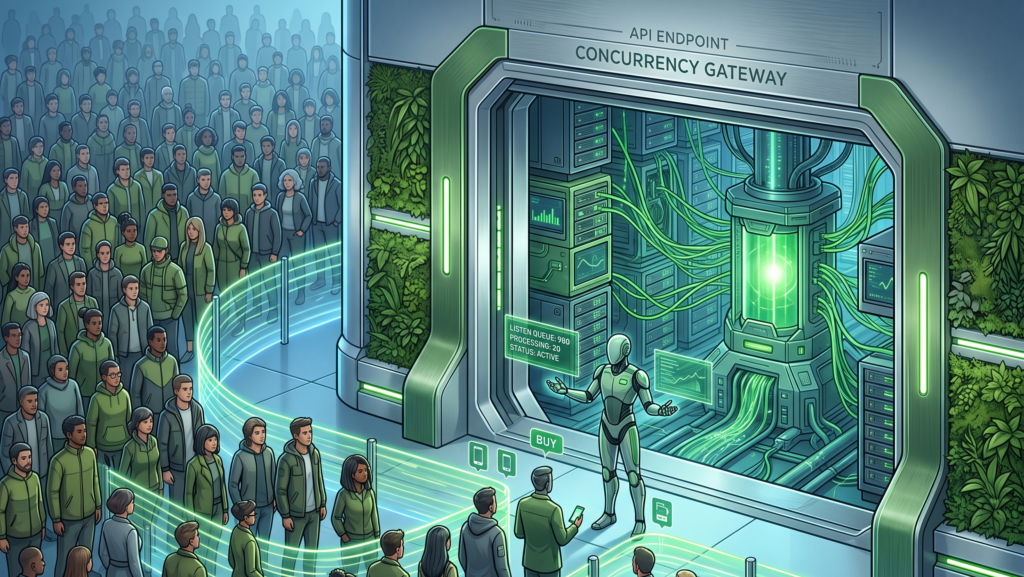
A highly anticipated pair of sneakers goes on sale at exactly noon. Across the country, one thousand human index fingers descend on one thousand glass screens in the exact same millisecond.
What happens next inside the silicon of the backend is a matter of profound public misunderstanding.
The popular intuition is divided into two camps. The first camp believes the application simply clones itself like a panicked flatworm, creating one thousand exact replicas to deal with the mob. The second camp believes a single server somehow handles everyone simultaneously through sheer computational magic. Neither is true. Your API is not cloning itself, and computers are terrible at magic.
The truth is much more mundane and involves a concept we all despise in the physical world. Your server handles a thousand simultaneous users the same way a single bathroom at a highway gas station handles a busload of tourists. It forms a line. The interesting part of cloud architecture is figuring out exactly where that line forms, how long it gets, and who gets turned away when the plumbing backs up.
Where the thousand requests actually land first
Before your beautifully crafted Python or Node.js application even realizes it has visitors, the operating system kernel is already working the door. The kernel is the ultimate bouncer.
When those thousand requests arrive, they hit a single listening socket. You can think of the listen() function as the velvet rope outside a nightclub. The operating system maintains two distinct queues here (the SYN queue for handshakes in progress, and the accept queue for fully established connections waiting for your app to notice them).
This is a crucial and often uncomfortable truth for developers. The very first waiting line was not written by you. It comes standard with Linux. The size of this line is dictated by obscure system settings like somaxconn. If a thousand people show up and the kernel’s queue can only hold one hundred and twenty-eight, the bouncer simply starts ignoring the rest. The users see “Connection Refused” or their browsers just hang in a state of hopeless retransmission. Your application code never even knew they existed.
Four ways to be in several places at once
Let us assume the bouncer lets them in. Now your application has to actually do the work. How does a single program process hundreds of people asking for shoes? Historically, we have tried four different ways to solve this.
The oldest method is one process per request (think of the early days of CGI or Apache prefork). When a request comes in, the server spawns a brand new, fully isolated process. It is highly secure and historically honest, but it is the equivalent of building a brand new kitchen every time a customer orders a sandwich. It is terribly expensive, and you will run out of RAM before you sell your tenth pair of shoes.
Then we moved to threads (the traditional Java or Tomcat model). Threads are lighter. You hire multiple tellers to work behind the same counter. They share the same space and the same memory. The problem here is the memory overhead per thread and the exhaustion of context switching. The CPU spends so much time frantically turning its attention from teller A to teller B that it forgets to actually process any transactions.
Then came the single-threaded event loop (the Node.js or Nginx philosophy). This model employs one insanely fast waiter taking orders from a hundred tables and passing them to the kitchen. It is brilliant and incredibly efficient for input and output operations. But it has a fatal flaw. If that single waiter stops to solve a complex Sudoku puzzle at table four (a CPU-bound task), the other ninety-nine tables starve to death.
Finally, we have modern lightweight concurrency (Go routines, Java 21 virtual threads, Python async). This is the current favorite. It allows the system to juggle thousands of tasks by instantly pausing any task that is waiting on a database or a network call, switching to another task without the heavy overhead of traditional threads. (Python developers using Gunicorn will still boot up multiple workers because of the Global Interpreter Lock, a stubborn piece of legacy architecture that essentially forces threads to share a single speaking token).
Your web server and your application are not the same thing
A quick point of clarification that confuses junior engineers daily. Uvicorn, Gunicorn, PHP-FPM, and Tomcat are not your application. They are the managers of your application.
People love to tweak the settings on these managers. They read a blog post that says the optimal number of workers is twice the number of CPU cores plus one. Then, when traffic spikes, they panic and crank the worker count up to two hundred. Bumping your workers to two hundred does not make your application faster. It usually just makes your server run out of memory much faster, crashing the entire machine with spectacular efficiency.
The bottleneck is rarely the thing you are optimizing
You can tune your web server all day, but the web server is rarely the problem. The bottleneck is the database.
Picture those one thousand concurrent users successfully navigating the kernel queues and the web server workers, only to slam into the database connection pool. A connection pool is exactly what it sounds like. It is a small bucket of open lines to the database. You might have a thousand users, but you probably only have twenty database connections.
This brings us to Little’s Law, a concept from queuing theory that explains why traffic jams happen. Throughput is equal to concurrency divided by latency. If your database takes a long time to answer (high latency), the only way to handle a lot of users (high throughput) is to have a massive amount of concurrency. But databases hate massive concurrency.
The most counterintuitive secret in cloud architecture is that sometimes, reducing the size of your connection pool actually makes your system faster. A database trying to serve twenty queries at once is fast. A database trying to serve five hundred queries at once spends all its time thrashing its disks and managing locks, slowing everyone down. By forcing requests to wait in the app server’s line, the database can do its job efficiently.
There are invisible queues everywhere. The thread pool is a queue. The disk scheduler is a queue. DNS resolution is a queue. If you rely on an external payment provider and their API takes three seconds to respond, you now have a three-second traffic jam backing up through every single one of those queues all the way to the user’s browser.
What happens when two people buy the last one
Let us look at the moment of purchase. There is one pair of sneakers left in the database. Two separate requests arrive at the same microsecond.
If you write your code to read the stock level, subtract one in the application, and save the new number, you are going to sell the same pair of shoes twice. Request A reads “1”. Request B reads “1”. Both subtract one. Both save “0”. You now have a very angry customer and a negative inventory. This is a race condition.
You cannot trust basic reads. You need locking. You can use optimistic locking (where you check a version number before saving to ensure nobody else touched the row while you were looking at it) or pessimistic locking (where you lock the row entirely with a command like SELECT FOR UPDATE until you are finished).
And if you think your database’s default isolation level protects you from this, you are in for a bad time. The default isolation level for many databases is READ COMMITTED, which absolutely does not prevent the scenario I just described.
The user who clicks buy three times
Humans are impatient creatures. When the browser spins for more than two seconds, the user will angrily click the “Buy Now” button again. And maybe a third time for good measure. Meanwhile, your load balancer might decide a request timed out and automatically retry it behind the scenes.
One eager human and a helpful network infrastructure can easily turn a single purchase into four identical requests hitting your backend.
This is why idempotency is not just a fancy engineering word, but a core product feature. Idempotency means that doing something multiple times has the same result as doing it once. Payment processors like Stripe handle this beautifully by requiring an idempotency key (a unique string generated by the client for that specific cart). No matter how many times the frantic user clicks, the backend sees the same key, processes the charge once, and simply replies “Yes, I already did that” to the subsequent requests.
I once audited a system that lacked idempotency keys during a Black Friday sale. A small network hiccup caused the load balancer to retry requests globally for about thirty seconds. They successfully sold out their inventory, but they also charged five hundred people three times each. Reversing those charges cost them more in engineering hours and banking fees than the profit from the entire sale.
Adding more servers, and the moment it stops helping
When the queues get too long, the modern reflex is to click the autoscaling button. Autoscaling spins up fresh copies of your application on new virtual machines to help carry the load.
The problem with autoscaling is structural delay. By the time your monitoring tools notice the CPU spiking, evaluate the metric, schedule a new server, boot the operating system, pull the container image, start the application, warm up the Just-In-Time compiler, fill the local caches, and finally register with the load balancer (a process that can take three to five minutes), the sneaker drop is over. The spike has already crushed you. Autoscaling is great for the gradual increase of traffic as people wake up across a time zone. It is completely useless for a localized stampede.
Even if you scale your web servers to infinity, you eventually hit the ultimate wall. The database is still just one machine. You cannot autoscale a primary database with a slider.
Learning to say no politely
If you cannot scale fast enough, and your queues are full, you have to start rejecting people. In systems architecture, this is called load shedding.
It feels unnatural to engineers to drop traffic on purpose. But a server trying to process everything will eventually run out of memory and process nothing. Dropping five percent of your traffic to ensure the other ninety-five percent actually completes their checkout is just good triage.
You need sensible timeouts. A thirty-second timeout on a web request is just a very slow way to crash your server. You need circuit breakers that trip and instantly return errors when a downstream service is struggling, rather than making a thousand requests wait in the dark. You can use explicit queues (like SQS or Kafka) to take the order instantly, return a “202 Accepted” status to the user, and process the actual payment asynchronously when the database has room to breathe.
So, one server or a thousand copies
We return to the original question. When a thousand users arrive at the exact same microsecond, the application does not undergo spontaneous mitosis. It does not clone itself like a panicked flatworm. Biology is elegantly scalable that way. Software, regrettably, is not.
There is no computational magic to be found here. There are only network sockets, kernel bouncers, exhausted thread pools, and database locks. Everything you look at is a queue. The network card has a queue. The database has a queue. The operating system maintains a queue just to keep track of its other queues.
The job of a cloud architect is not to eliminate these lines. That is mathematically impossible. The job is more akin to being a cynical municipal planner. You decide exactly where the traffic jams should happen, how long the wait is allowed to get before it becomes embarrassing, and at what precise moment the bouncer should lock the doors and tell the remaining crowd to go home.
A server, ultimately, does not care about your limited edition sneakers or your concert tickets. It is just a box of hot silicon trying desperately to force a thousand screaming humans to do the one thing they hate most. It wants them to form a single, orderly line.